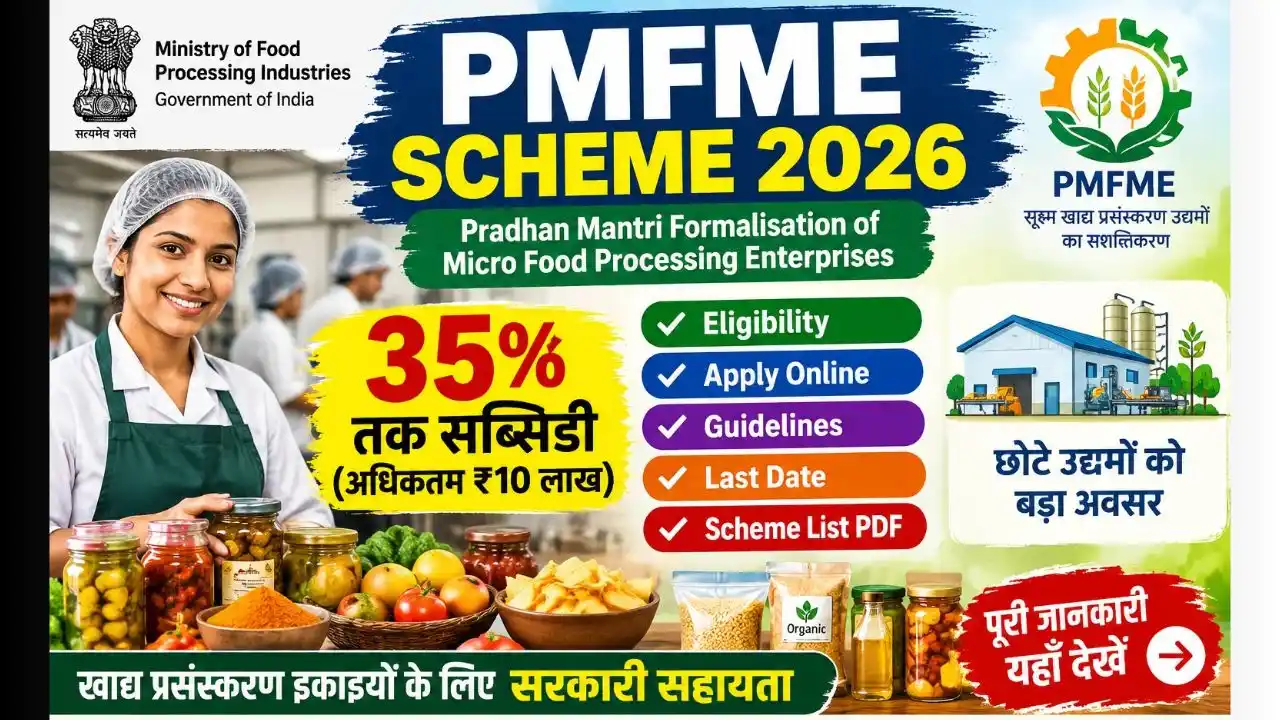
The PMFME Scheme is a Government of India initiative designed to support and formalise micro food processing enterprises across the country. The scheme provides financial, technical, training and business support to eligible food processing businesses, including individual entrepreneurs, Self-Help Groups (SHGs), Farmer Producer Organisations (FPOs) and cooperatives.
One of the most searched benefits under the scheme is the PMFME Scheme subsidy, under which eligible individual micro food processing units can receive a credit-linked capital subsidy of 35% of the eligible project cost, subject to a maximum of ₹10 lakh per unit. The beneficiary is required to contribute at least 10% of the project cost, with the remaining amount generally financed through a bank loan.
This article explains the PMFME Scheme 2026, PMFME subsidy, eligibility, application process, guidelines, launch date, last date, scheme list PDF and other important details.
PMFME Scheme – Overview
PMFME stands for Pradhan Mantri Formalisation of Micro Food Processing Enterprises Scheme. It is implemented by the Ministry of Food Processing Industries (MoFPI), Government of India.
The scheme was introduced under the Aatmanirbhar Bharat initiative with the objective of strengthening small and micro food processing businesses and helping them move towards formalisation.
The scheme follows the One District One Product (ODOP) approach, under which food processing activities are linked with products identified for particular districts. The official PMFME portal lists ODOP information and scheme components.
PMFME Scheme Key Details
| Particular | Details |
|---|---|
| Scheme Name | Pradhan Mantri Formalisation of Micro Food Processing Enterprises |
| Short Name | PMFME |
| Ministry | Ministry of Food Processing Industries |
| Government | Government of India |
| Launch Year | 2020 |
| Original Scheme Period | 2020-21 to 2024-25 |
| Main Focus | Micro food processing enterprises |
| Individual Subsidy | 35% of eligible project cost |
| Maximum Individual Subsidy | ₹10 lakh |
| Minimum Beneficiary Contribution | 10% |
| Approach | One District One Product (ODOP) |
| Major Beneficiaries | Individuals, SHGs, FPOs, Cooperatives and other eligible groups |
| Official Portal | PMFME Portal |
What is PMFME Scheme?
The PMFME Scheme aims to improve the competitiveness of micro food processing enterprises and encourage businesses operating in the unorganised food processing sector to become more formal and sustainable.
The scheme provides assistance for activities such as setting up or upgrading food processing units, purchasing eligible plant and machinery, technical civil work, training, branding, marketing and common infrastructure.
For individual micro food processing enterprises, the Ministry provides credit-linked capital subsidy at 35% of eligible project cost, subject to the maximum ceiling of ₹10 lakh.
The scheme also supports groups such as FPOs, SHGs and producer cooperatives through different components.
PMFME Scheme Launch Date
The PMFME Scheme was launched in 2020. The original scheme was designed as a five-year programme covering the financial years 2020-21 to 2024-25, with an overall outlay of ₹10,000 crore.
The scheme was designed to directly assist micro food processing enterprises and support their formalisation, capacity building and value-chain development.
Therefore, people searching for “PMFME Scheme launch date” should understand that the scheme originated in 2020, rather than being a newly launched 2026 scheme.
PMFME Scheme Subsidy
The PMFME Scheme subsidy is one of its major attractions for eligible entrepreneurs.
For an individual micro food processing unit, the scheme provides:
- 35% credit-linked capital subsidy
- Maximum subsidy of ₹10 lakh per unit
- Minimum beneficiary contribution of 10% of project cost
- Remaining funding generally comes through a bank loan
The eligible project cost includes eligible plant and machinery and technical civil work. The official modification to the guidelines specifies that technical civil work should not exceed 30% of eligible project cost and that land cost, rental or lease-related work shed costs are excluded.
PMFME Subsidy Example
Suppose an eligible entrepreneur has an eligible project cost of ₹20 lakh.
At 35%, the calculated subsidy would be:
₹20 lakh × 35% = ₹7 lakh
Therefore, subject to approval and other scheme conditions, the subsidy could be ₹7 lakh.
If the eligible project cost is ₹30 lakh:
₹30 lakh × 35% = ₹10.50 lakh
However, because the individual-unit subsidy is capped at ₹10 lakh, the maximum subsidy would be ₹10 lakh.
The subsidy is credit-linked, so applicants should not assume that the entire subsidy is simply transferred to their personal bank account as unrestricted cash.
PMFME Scheme Subsidy for SHGs
The PMFME Scheme also provides support to Self-Help Groups.
Eligible SHG members involved in food processing can receive seed capital of ₹40,000 per member for working capital and purchase of small tools, subject to the applicable scheme conditions and limits.
The official Ministry information also provides for support to individual SHG members as food processing units through a 35% credit-linked grant, subject to the ₹10 lakh maximum applicable to the individual-unit component.
This component can be particularly relevant for SHGs involved in activities such as food preparation, processing, packaging and other eligible food-based enterprises.
PMFME Scheme Eligibility
The exact eligibility depends on the category of applicant and the component under which assistance is being requested.
For individual micro food processing enterprises, the scheme supports existing units for upgradation as well as eligible new micro food processing enterprises.
According to the modified guidelines, enterprises involved in the district’s identified ODOP product receive preference, although other eligible micro enterprises may also be considered subject to scheme conditions.
Basic Eligibility Considerations
An applicant should generally consider the following:
- The proposed activity should fall within an eligible food processing activity.
- The applicant should satisfy the applicable micro-enterprise requirements.
- The project should be financially and technically viable.
- The applicant should be able to contribute the required beneficiary share.
- The project should meet the applicable bank and PMFME documentation requirements.
- The proposed investment should comply with eligible project-cost rules.
- ODOP products receive preference under the scheme framework.
Applicants should always check the latest official guidelines before submitting an application because eligibility can differ according to the applicant category and project component.
Who Can Apply for PMFME Scheme?
Different categories can receive support under PMFME, depending on the component.
These may include:
- Individual entrepreneurs
- Proprietorship firms
- Partnership firms
- Farmer Producer Organisations
- Self-Help Groups
- Producer cooperatives
- Cooperatives
- Certain eligible private organisations
- Government agencies for applicable common infrastructure components
The official PMFME portal identifies individual units, groups and common infrastructure as major application categories.
PMFME Scheme Benefits
The PMFME Scheme provides more than just subsidy assistance.
1. Credit-Linked Subsidy
Eligible individual units can receive a 35% credit-linked capital subsidy, subject to the maximum limit of ₹10 lakh.
2. Support for New and Existing Units
The modified guidelines provide support for eligible existing units seeking upgradation as well as eligible new micro food processing enterprises.
3. One District One Product
The ODOP approach helps focus resources on products associated with particular districts.
4. Training
Beneficiaries can receive capacity-building and training support related to entrepreneurship, food processing, hygiene, packaging, marketing and other business requirements.
5. Branding and Marketing
The scheme provides support for branding and marketing to eligible groups of FPOs, SHGs, cooperatives or suitable SPVs. The official PMFME portal states that financial assistance of up to 50% is available for eligible branding and marketing support.
6. Common Infrastructure
Eligible organisations can receive assistance for common facilities such as sorting, grading, storage and common processing facilities.
PMFME Scheme Subsidy Guidelines
The PMFME Scheme subsidy guidelines are important because the subsidy is not calculated on every expense incurred by an applicant.
For individual units, the eligible project cost includes eligible plant and machinery and technical civil work. Land cost and certain rental/lease expenses are excluded. Technical civil work is subject to the applicable percentage limit under the guidelines.
The beneficiary contribution is also important. The modified guidelines specify a minimum 10% beneficiary contribution, while the balance is required to be financed through a bank loan.
Therefore, applicants should prepare a realistic project report and understand which expenses are eligible before applying.
How to Apply for PMFME Scheme Online?
Applicants searching for “PMFME Scheme subsidy Apply Online” should use the official PMFME system and follow the current instructions provided by MoFPI.
The general process is as follows:
Step 1: Check Your Eligibility
First identify whether you are applying as an individual entrepreneur, SHG, FPO, cooperative or another eligible category.
Step 2: Identify the Food Processing Activity
Select the proposed food processing activity and check whether it is eligible under PMFME.
If applicable, check whether your proposed activity matches the ODOP product of your district.
Step 3: Prepare Your Project Details
Prepare information about:
- Business activity
- Project cost
- Machinery requirements
- Raw materials
- Production capacity
- Employment
- Marketing plan
- Expected turnover
- Financial projections
- Bank finance requirement
Step 4: Prepare the Required Documents
Depending on the applicant and project, documents may include identity proof, address proof, bank details, business-related documents, project report, quotations for machinery and other documents requested by the authorities or bank.
Step 5: Submit the Application
Submit the application through the official PMFME application system when applications are available.
The official portal is maintained by the Ministry of Food Processing Industries. At the time of writing, the portal page indicates that maintenance activity may affect access, so applicants should use the official Ministry/PMFME website for the latest application instructions.
Step 6: Application Scrutiny
The application is examined through the applicable PMFME process. Project viability, eligibility and other requirements are considered.
Step 7: Bank Loan Processing
Because the individual subsidy is credit-linked, bank financing is an important part of the process.
Step 8: Project Implementation
After the required approvals and financing, the entrepreneur proceeds with the eligible project according to the applicable conditions.
PMFME Scheme Documents Required
The exact document list may vary according to the applicant and project.
Commonly required information can include:
| Document/Information | Purpose |
|---|---|
| Aadhaar/Identity Proof | Applicant identification |
| PAN | Financial/business identification |
| Bank Account Details | Banking and financial processing |
| Business Details | Enterprise verification |
| Project Report/DPR | Project assessment |
| Machinery Quotations | Cost assessment |
| Address Proof | Applicant/unit verification |
| Photographs | Application documentation |
| Registration Documents | Where applicable |
| Loan/Bank Documents | Credit-linked assistance |
Applicants should check the current official checklist before submitting their application because additional documents may be required.
PMFME Scheme List PDF
Many users search for “PMFME Scheme list PDF” or “PMFME Scheme subsidy list PDF” to find eligible products, ODOP products, guidelines or beneficiary-related information.
There is not necessarily one single PDF containing every type of PMFME information.
The official PMFME system contains different resources, including information relating to:
- ODOP products
- Scheme guidelines
- Training
- District-level information
- Applications
- Common infrastructure
- FPOs and SHGs
- Other scheme documents
The official PMFME portal provides an ODOP section and other scheme resources.
Therefore, users should avoid downloading random “PMFME list PDF” files from unofficial websites. Always verify the document against the Ministry of Food Processing Industries or official PMFME portal.
PMFME Scheme Last Date
The keyword “PMFME Scheme last date” is frequently searched online.
The original PMFME Scheme was designed for the period 2020-21 to 2024-25.
However, the official PMFME portal remains available and the Ministry’s website continues to publish PMFME-related information and updates in 2026.
Therefore, applicants should not assume that a date published on an old article is the current application deadline. The latest application availability and deadlines should be checked directly through the official PMFME portal or Ministry of Food Processing Industries.
PMFME Scheme and One District One Product (ODOP)
ODOP is an important part of PMFME.
The objective is to promote products that have potential in a particular district and develop a stronger ecosystem around procurement, processing, common services and marketing.
The official PMFME portal reports ODOP coverage across districts and provides an ODOP section for checking relevant information.
For example, a district may focus on a particular agricultural or food product, allowing entrepreneurs working with that product to benefit from an ecosystem involving processing, packaging, storage and marketing.
PMFME Common Infrastructure Support
PMFME is not restricted to individual businesses.
Under the common infrastructure component, eligible organisations can receive support for facilities such as:
- Agricultural produce sorting
- Grading
- Warehousing
- Cold storage
- Common processing facilities
- Value-chain infrastructure
- Incubation-related facilities
The official Ministry states that common infrastructure support is available to eligible FPOs, SHGs, cooperatives, government agencies and other eligible entities, with a credit-linked grant of 35% subject to applicable limits.
Important Points Before Applying for PMFME
Before submitting an application, applicants should remember:
- PMFME subsidy is credit-linked.
- The individual-unit subsidy is 35% of eligible project cost, subject to the ₹10 lakh maximum.
- At least 10% beneficiary contribution is required for the applicable individual component.
- Not every business expense is eligible for subsidy.
- Land cost is not included in eligible project cost under the applicable individual-unit guidelines.
- ODOP products receive preference under the scheme framework.
- Bank approval is an important part of credit-linked assistance.
- The latest official guidelines should always be checked before applying.
- Do not rely solely on old PMFME last-date information published on third-party websites.
Frequently Asked Questions About PMFME Scheme
– What is PMFME Scheme?
PMFME is the Pradhan Mantri Formalisation of Micro Food Processing Enterprises Scheme, implemented by the Ministry of Food Processing Industries to support and formalise micro food processing enterprises.
– What is the PMFME subsidy percentage?
For eligible individual micro food processing units, the credit-linked capital subsidy is 35% of eligible project cost, subject to a maximum of ₹10 lakh per unit.
– What is the maximum PMFME subsidy?
The maximum subsidy for an eligible individual unit is ₹10 lakh.
– Is PMFME subsidy a direct cash payment?
The individual-unit assistance is a credit-linked capital subsidy, so it is associated with bank financing rather than being an unrestricted direct cash payment.
– What is the PMFME launch date?
The PMFME Scheme was launched in 2020 and was originally designed for the five-year period from 2020-21 to 2024-25.
– Can a new food processing unit apply?
The modified PMFME guidelines provide for support to eligible new as well as existing micro food processing enterprises, subject to applicable conditions.
– Is there a PMFME Scheme last date in 2026?
The original scheme period ended in 2024-25, but the official PMFME portal and Ministry pages continue to carry PMFME information and updates in 2026. Applicants should check the official portal for the current application status and any applicable deadline rather than relying on an old date.
– Where can I get PMFME Scheme guidelines PDF?
The official PMFME portal and Ministry of Food Processing Industries website provide scheme-related guidelines and documents.
Conclusion
The PMFME Scheme is an important government support programme for micro food processing enterprises. Its major individual-unit benefit is a 35% credit-linked capital subsidy up to ₹10 lakh, along with training, capacity building and other forms of support.
The scheme also covers SHGs, FPOs, cooperatives and eligible common infrastructure projects. The One District One Product (ODOP) approach is another important feature of PMFME.
If you are planning to start or upgrade a food processing business, carefully check the PMFME eligibility, eligible project cost, subsidy guidelines, bank loan requirements and current application status before submitting your application.
For the latest information, applicants should rely on the official Ministry of Food Processing Industries and PMFME portal, rather than unofficial PMFME list PDFs or outdated last-date claims.
Also read:-

Dharitri Assam is an Assam-focused information platform providing the latest updates on government jobs, education, schemes, scholarships, admit cards, results, and career opportunities. Our goal is to make useful and reliable information easy to understand and accessible to everyone in Assam.