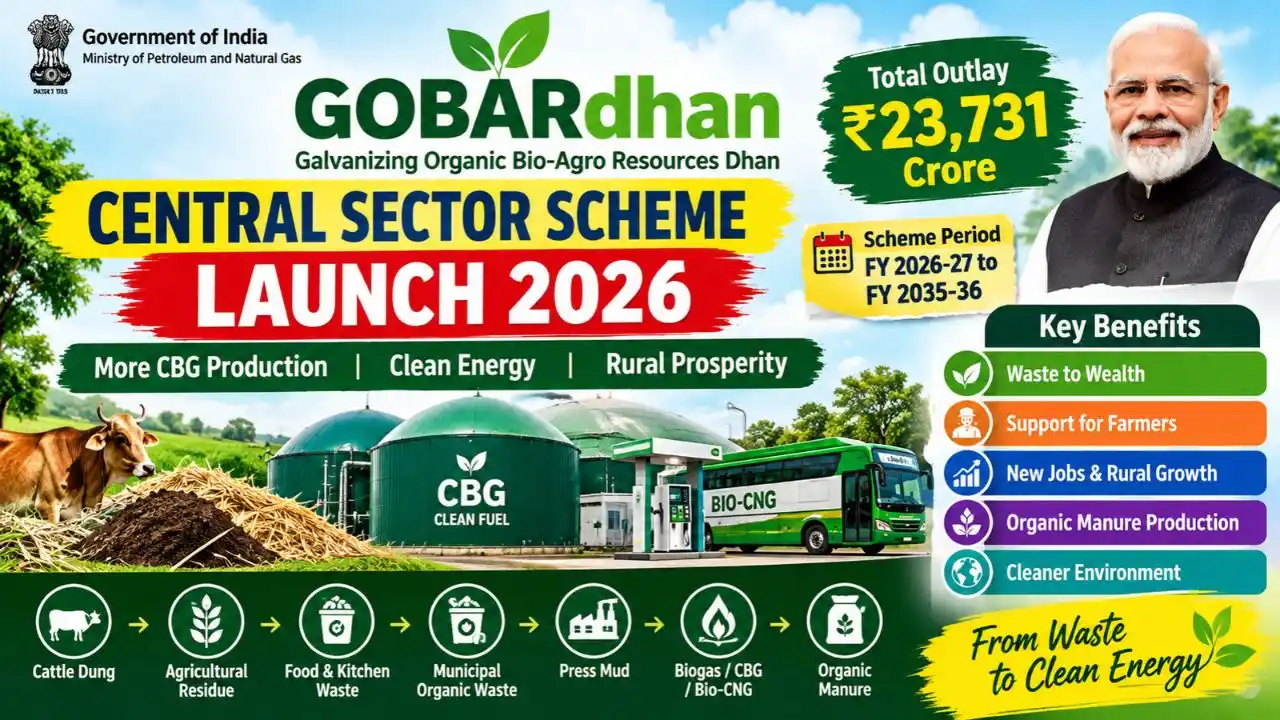
GOBARdhan Central Sector Scheme Launch 2026: The Government of India has launched a new Central Sector Scheme named GOBARdhan to accelerate the development of the Compressed Biogas (CBG) sector in the country. The new scheme provides a long-term framework for increasing domestic CBG production, supporting farmers and rural entrepreneurs, creating investment opportunities and converting organic waste into useful energy.
The Union Cabinet approved the new GOBARdhan scheme on 6 August 2026 with a total financial outlay of ₹23,731 crore. The scheme provides a 10-year framework from Financial Year 2026-27 to 2035-36. It was formally launched on 1 October 2026 by Union Minister for Petroleum and Natural Gas Hardeep Singh Puri.
The new Central Sector Scheme should not be confused with the original GOBARdhan initiative launched in 2018. The original initiative focused strongly on rural sanitation, organic waste management and community biogas plants under the Swachh Bharat Mission (Grameen), while the 2026 Central Sector Scheme creates an integrated national framework specifically aimed at scaling up the Compressed Biogas sector.
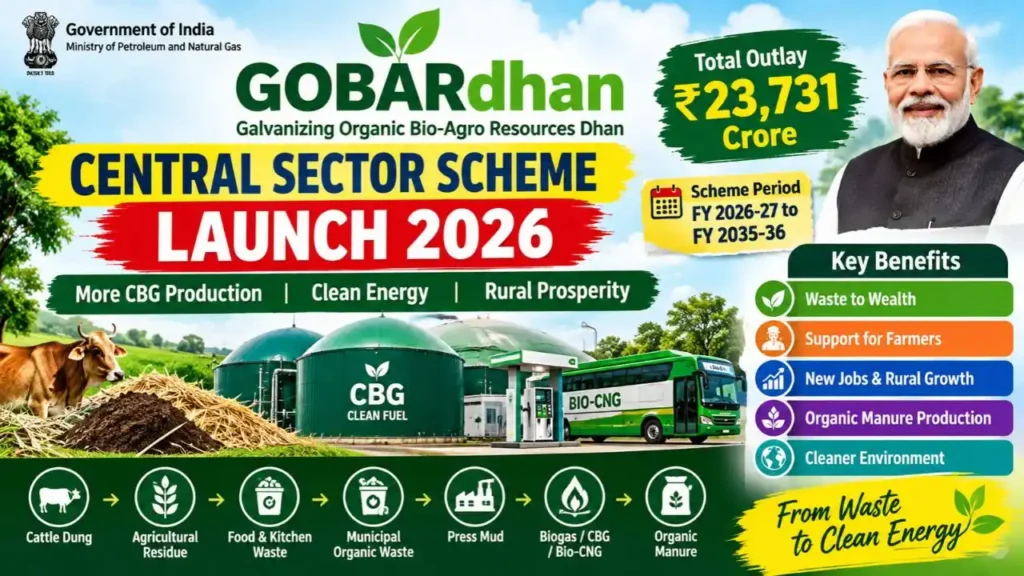
What is GOBARdhan?
GOBARdhan stands for Galvanizing Organic Bio-Agro Resources Dhan.
The initiative focuses on converting organic waste such as:
- Cattle dung
- Agricultural residue
- Food and kitchen waste
- Municipal organic waste
- Press mud
- Other biodegradable biomass
into useful products such as biogas, Compressed Biogas (CBG), bio-CNG and organic manure.
The basic idea is simple: instead of allowing organic waste to become a sanitation and environmental problem, it can be processed into energy and agricultural products.
The Government of India’s GOBARdhan initiative was originally announced in the 2018 Union Budget and launched on 30 April 2018 under the Department of Drinking Water and Sanitation.
GOBARdhan Central Sector Scheme Launch Date 2026
The GOBARdhan Central Sector Scheme came into effect from 1 September 2026, according to Akashvani’s report on the implementation of the scheme. The scheme was subsequently formally launched on 1 October 2026 by the Ministry of Petroleum and Natural Gas.
Important GOBARdhan dates
| Event | Date/Period |
|---|---|
| GOBARdhan announced in Budget | February 2018 |
| Original GOBARdhan initiative launched | 30 April 2018 |
| Unified GOBARdhan Registration Portal launched | 1 June 2023 |
| New Central Sector Scheme approved | 6 August 2026 |
| Central Sector Scheme came into effect | 1 September 2026 |
| New Central Sector Scheme formally launched | 1 October 2026 |
| Scheme period | FY 2026-27 to FY 2035-36 |
| Total outlay | ₹23,731 crore |
The 2026 launch represents a major expansion of the GOBARdhan framework toward large-scale CBG production and development of a circular bioeconomy.
GOBARdhan Central Sector Scheme 2026
The new GOBARdhan Central Sector Scheme has been designed as a national framework for the development of the Compressed Biogas sector.
The Union Cabinet approved the scheme with a total outlay of ₹23,731 crore. The framework is intended to run for ten years, covering FY 2026-27 to FY 2035-36.
One of the major objectives is to increase India’s domestic CBG production by nearly 10 times, reaching around 5 MMSCMD.
The government also aims to provide greater certainty to investors and lenders through measures including assured offtake, stable pricing, capital assistance, pipeline connectivity and access to finance.
Why Was the GOBARdhan Central Sector Scheme Launched?
India produces large quantities of agricultural residue, cattle dung and other organic waste. If this waste is not properly managed, it can create problems related to pollution, sanitation and disposal.
GOBARdhan attempts to convert this waste into economic resources.
The new Central Sector Scheme has been introduced to address several objectives:
1. Increase CBG Production
A major objective is to significantly increase domestic production of Compressed Biogas.
CBG can be produced by processing organic feedstocks through anaerobic digestion and upgrading the resulting biogas.
2. Convert Waste Into Wealth
The scheme promotes the concept of waste-to-wealth.
Organic materials that were previously treated as waste can become sources of:
- Clean fuel
- Organic manure
- Rural income
- Employment
- Business opportunities
3. Support Farmers
Farmers can potentially benefit from markets for agricultural residues and cattle waste while also obtaining useful organic manure from biogas production.
4. Promote Rural Entrepreneurship
CBG and biogas projects can create opportunities for entrepreneurs, cooperatives and other organizations involved in waste collection, processing and energy production.
5. Strengthen Energy Security
Increasing domestic production of alternative gaseous fuels can contribute to India’s broader energy-security objectives.
What Is Compressed Biogas (CBG)?
Compressed Biogas, commonly called CBG, is a purified form of biogas.
Biogas is produced when biodegradable organic matter is broken down in an oxygen-free environment. The gas can then be purified by removing unwanted components and compressed for use as a fuel.
CBG can have applications in areas where gaseous fuels are used, including transportation and industrial applications.
The GOBARdhan framework therefore connects waste management, agriculture, rural development and clean energy.
GOBARdhan Central Sector Scheme Financial Outlay
The new scheme has a total financial outlay of: ₹23,731 Crore
The large financial framework is intended to create a more predictable environment for the development of India’s CBG ecosystem.
According to the Union Cabinet announcement, the scheme is expected to support CBG development through an integrated framework involving assured offtake, stable pricing, capital assistance, pipeline connectivity and access to finance.
The scheme’s 10-year period is another important feature because large bioenergy projects generally require significant investment and long-term planning.
Main Objectives of GOBARdhan Scheme 2026
The important objectives of the GOBARdhan Central Sector Scheme include:
- Increase domestic CBG production.
- Promote conversion of organic waste into clean energy.
- Encourage private investment in the CBG sector.
- Support farmers and rural entrepreneurs.
- Develop a strong CBG ecosystem.
- Promote circular bioeconomy.
- Improve utilization of agricultural residue.
- Generate employment opportunities.
- Support organic manure production.
- Contribute to India’s energy-security goals.
The government has described the scheme as a national framework intended to accelerate the CBG sector and support waste-to-wealth activities.
Major Features of GOBARdhan Central Sector Scheme
The 2026 Central Sector Scheme contains several important features.
Assured Offtake
The scheme framework includes mechanisms intended to provide greater certainty regarding the offtake of CBG.
This can be important for project developers because long-term demand visibility can influence investment decisions.
Stable Pricing Framework
The scheme also provides a framework aimed at greater pricing stability, which can improve predictability for businesses and financial institutions.
Capital Assistance
Capital support is included as part of the integrated framework to facilitate development of CBG projects.
Pipeline Connectivity
Pipeline connectivity is another component of the framework, helping integrate CBG production with relevant gas infrastructure.
Credit Support
The scheme also emphasizes access to finance and credit support for the CBG ecosystem.
These measures are designed to address some of the infrastructure and financing challenges associated with developing large-scale CBG projects.
GOBARdhan Scheme Benefits
The scheme can provide benefits across several sectors.
| Area | Expected Benefit |
|---|---|
| Farmers | Better utilization of cattle dung and agricultural residue |
| Rural areas | New business and employment opportunities |
| Environment | Better organic waste management |
| Energy | Increased domestic CBG production |
| Agriculture | Availability of organic manure/bio-slurry |
| Entrepreneurs | Opportunities in biogas and CBG projects |
| Industry | Additional clean gaseous fuel source |
| Government | Progress toward circular bioeconomy |
| Waste management | Conversion of organic waste into useful products |
The official GOBARdhan portal lists advantages including circular-economy promotion, eco-friendly fuel, effective waste management, employment generation, organic manure production and reduction of greenhouse-gas emissions.
GOBARdhan and Farmers
Farmers are an important part of the GOBARdhan ecosystem because agricultural residues and cattle dung can serve as feedstock for biogas and CBG production.
Instead of burning or disposing of agricultural residue, it can potentially be collected and processed.
The process can produce two valuable outputs:
Biogas/CBG + Bio-slurry
The gas can be used as an energy source, while the remaining bio-slurry can be processed or utilized as organic manure.
This creates the possibility of linking agricultural waste management with energy production.
GOBARdhan and Rural Employment
The development of CBG and biogas plants can create employment opportunities across the value chain.
These opportunities may include:
- Waste collection
- Biomass transportation
- Plant operations
- Equipment maintenance
- Feedstock management
- Processing
- Marketing
- Organic manure handling
Therefore, the scheme is not only related to energy production but also to rural economic activity.
GOBARdhan and Circular Economy
A circular economy attempts to keep resources in productive use for as long as possible and reduce waste.
GOBARdhan follows this principle by converting organic waste into useful products.
For example:
Cattle dung → Biogas → CBG + Bio-slurry → Fuel + Organic manure
Similarly:
Agricultural residue → Biogas production → CBG + organic by-products
This approach can reduce waste while generating economic value.
GOBARdhan Central Sector Scheme vs Original GOBARdhan Initiative
This is one of the most important points for anyone searching for “GOBARdhan Central Sector Scheme launch.”
The name GOBARdhan existed before the 2026 Central Sector Scheme.
The original GOBARdhan initiative was launched in 2018 under the rural sanitation framework. It became an integral component of Solid Waste Management under Swachh Bharat Mission (Grameen).
The new 2026 Central Sector Scheme builds a national framework around the CBG sector.
| Feature | Original GOBARdhan Initiative | 2026 Central Sector Scheme |
|---|---|---|
| Origin | 2018 | Approved in 2026 |
| Original launch | 30 April 2018 | Formal launch 1 October 2026 |
| Main emphasis | Organic waste management and biogas | CBG sector development |
| Framework | SBM-G and broader umbrella initiative | Central Sector Scheme |
| Major focus | Rural sanitation, waste-to-wealth | Scaling CBG production |
| Financial framework | Different programme components | ₹23,731 crore |
| Period | Implemented through relevant government programmes | FY 2026-27 to FY 2035-36 |
| Target | Village-level waste and biogas management | Nearly ten-fold CBG growth |
This distinction is important because both are referred to as GOBARdhan, but they represent different stages and components of the government’s broader bioenergy initiative.
GOBARdhan Under Swachh Bharat Mission
The original GOBARdhan programme is closely associated with Swachh Bharat Mission (Grameen).
Under SBM-G Phase II, GOBARdhan is an integral component of solid and liquid waste management and supports community and cluster-level biogas plants.
The official GOBARdhan portal states that financial assistance of up to ₹50 lakh per district is available under SBM-G Phase II for community and cluster biogas plants for the programme period 2020-21 to 2026-27.
This support is separate from the overall ₹23,731-crore framework of the newly approved 2026 Central Sector Scheme.
GOBARdhan Unified Registration Portal
The Government launched the Unified Registration Portal for GOBARdhan on 1 June 2023.
The portal was created to provide a single registration mechanism for Biogas, CBG and Bio-CNG plants.
Government entities, private organizations, cooperatives and other eligible entities operating or intending to establish relevant plants can register through the system.
The portal is designed to streamline registration and help connect projects with various government support mechanisms.
Who Can Benefit From GOBARdhan?
The broader GOBARdhan ecosystem can involve several categories of stakeholders, including:
- Farmers
- Farmer groups
- Cooperatives
- Rural entrepreneurs
- Private companies
- Biogas plant operators
- CBG project developers
- Local bodies
- Government agencies
- Technology providers
- Financial institutions
The exact eligibility and financial support available to a particular project depend on the relevant component, guidelines and implementing ministry.
Therefore, applicants should always check the latest official guidelines before making an investment or application.
GOBARdhan Scheme and Waste-to-Wealth
The central concept behind GOBARdhan is waste-to-wealth.
India has significant quantities of organic resources that can be used for bioenergy production.
The scheme seeks to create an ecosystem where these resources can be collected, processed and converted into commercially useful products.
This can potentially provide benefits in three areas:
Environmental Benefit
Better management of organic waste can reduce uncontrolled disposal and associated pollution.
Economic Benefit
Waste can become an input for energy and agricultural products.
Social Benefit
New activities related to collection, transportation and processing can create livelihood opportunities.
How GOBARdhan Can Help the CBG Sector
Developing a CBG plant requires more than just technology.
A successful project also needs:
- Reliable feedstock
- Transportation
- Processing infrastructure
- Financing
- Buyers
- Gas connectivity
- Regulatory support
- Long-term business planning
The new Central Sector Scheme attempts to address several of these requirements through an integrated framework involving offtake, pricing, capital assistance, connectivity and finance.
GOBARdhan Central Sector Scheme: Key Facts
| Particular | Details |
|---|---|
| Scheme Name | GOBARdhan Central Sector Scheme |
| Full Form | Galvanizing Organic Bio-Agro Resources Dhan |
| Sector | Compressed Biogas/Bioenergy |
| Cabinet Approval | 6 August 2026 |
| Effective From | 1 September 2026 |
| Formal Launch | 1 October 2026 |
| Total Outlay | ₹23,731 crore |
| Scheme Period | FY 2026-27 to FY 2035-36 |
| CBG Production Goal | Nearly 10-fold increase |
| Target Production | Around 5 MMSCMD |
| Major Ministry for new CBG framework | Ministry of Petroleum and Natural Gas |
| Original GOBARdhan Initiative | Launched in 2018 |
| Original rural sanitation component | Swachh Bharat Mission (Grameen) |
The figures and dates above are based on official government releases available as of October 2026.
GOBARdhan Central Sector Scheme 2026: Frequently Asked Questions
– When was GOBARdhan originally launched?
The original GOBARdhan initiative was launched on 30 April 2018 by the Department of Drinking Water and Sanitation.
– When was the new GOBARdhan Central Sector Scheme approved?
The Union Cabinet approved the new Central Sector Scheme on 6 August 2026.
– When was the GOBARdhan Central Sector Scheme launched?
The new scheme was formally launched on 1 October 2026 by Union Minister for Petroleum and Natural Gas Hardeep Singh Puri.
– What is the total outlay of the scheme?
The total financial outlay is ₹23,731 crore.
– What is the duration of the scheme?
The Central Sector Scheme provides a 10-year framework covering FY 2026-27 to FY 2035-36.
– What is the main objective of the new scheme?
The main objective is to accelerate India’s Compressed Biogas sector, with the government targeting nearly a ten-fold increase in domestic CBG production to around 5 MMSCMD.
– Is GOBARdhan only for cattle dung?
No. GOBARdhan covers a broader range of organic resources, including agricultural residue, cattle dung and other biodegradable organic waste.
– Is GOBARdhan the same as a biogas subsidy scheme?
Not exactly. GOBARdhan is a broader umbrella initiative. Different components and government programmes can provide different forms of support for biogas and CBG projects.
– What is the GOBARdhan portal?
The GOBARdhan Unified Registration Portal provides a centralized registration mechanism for relevant biogas, CBG and Bio-CNG plants. The portal was launched in 2023.
Conclusion
The GOBARdhan Central Sector Scheme Launch 2026 represents a new phase in India’s effort to develop the Compressed Biogas sector.
While GOBARdhan originally began in 2018 with a strong focus on rural sanitation, organic waste management and biogas, the new 2026 Central Sector Scheme provides a much larger national framework focused on expanding CBG production.
With an outlay of ₹23,731 crore, a 10-year implementation period and a target of nearly ten-fold growth in domestic CBG production, the scheme is designed to bring together waste management, agriculture, energy production, infrastructure, finance and rural entrepreneurship.
For farmers, entrepreneurs and organizations interested in biogas or CBG projects, it is important to distinguish between the various GOBARdhan components and check the latest official guidelines before applying for any financial assistance.
As the programme develops, GOBARdhan is expected to remain an important part of India’s broader effort to turn organic waste into energy, manure and economic value.
Also read:-

Dharitri Assam is an Assam-focused information platform providing the latest updates on government jobs, education, schemes, scholarships, admit cards, results, and career opportunities. Our goal is to make useful and reliable information easy to understand and accessible to everyone in Assam.