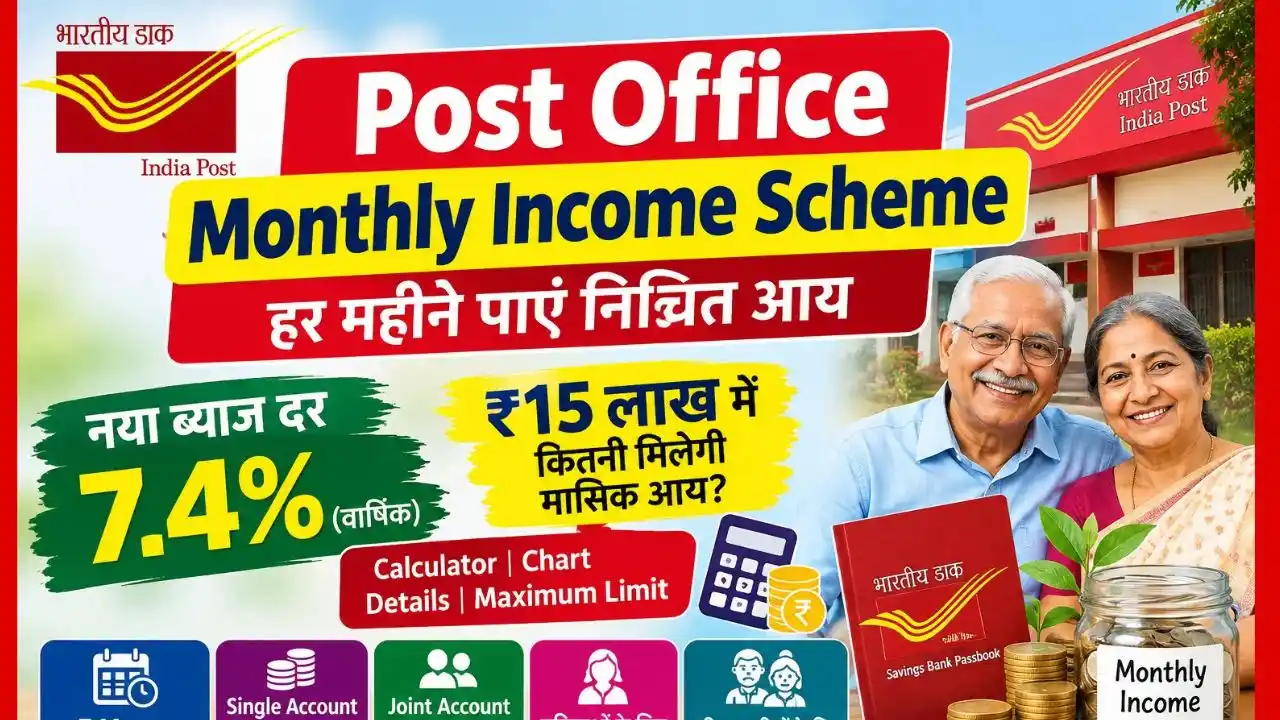
The Post Office Monthly Income Scheme (MIS) is a popular government-backed small savings scheme for investors who want a fixed monthly income from a lump-sum investment. Under this scheme, an investor deposits a certain amount for a fixed tenure and receives interest every month.
For the July–September 2026 quarter, the Post Office Monthly Income Account Scheme is offering an interest rate of 7.4% per annum, with interest paid monthly. The maximum deposit is ₹9 lakh in a single account and ₹15 lakh in a joint account.
This article explains the Post Office Monthly Income Scheme 2026, latest interest rate, ₹15 lakh monthly income calculation, eligibility, maximum limit, benefits, premature closure rules, and how the scheme can be useful for women and senior citizens.
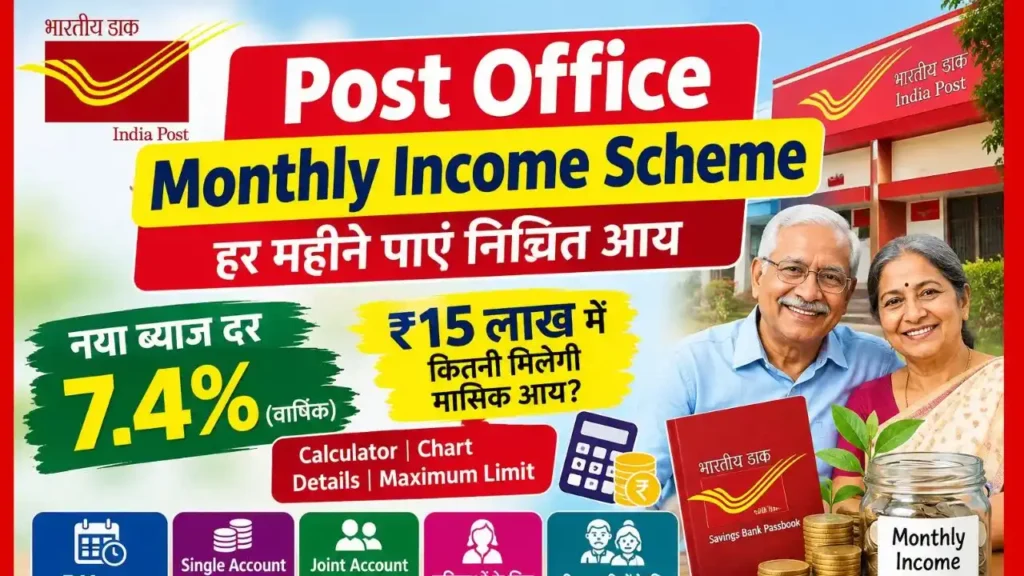
Post Office Monthly Income Scheme 2026
The official name of the scheme is the National Savings Monthly Income Account (MIS). It is operated through India Post and is designed for people who want regular monthly interest rather than waiting until maturity for their returns.
The scheme has a 5-year tenure. Investors deposit a lump sum, receive interest every month, and receive their principal amount back after completion of the five-year term, subject to the applicable rules. India Post’s scheme material confirms the ₹9 lakh single-account and ₹15 lakh joint-account limits.
Unlike a recurring deposit, you do not need to deposit money every month. Instead, you make a one-time deposit and receive monthly interest.
Key Features at a Glance
| Feature | Details |
|---|---|
| Scheme Name | National Savings Monthly Income Account |
| Popular Name | Post Office Monthly Income Scheme / MIS |
| Current Interest Rate | 7.4% per annum |
| Interest Payment | Monthly |
| Tenure | 5 years |
| Minimum Deposit | ₹1,000 |
| Maximum Single Account | ₹9 lakh |
| Maximum Joint Account | ₹15 lakh |
| Joint Account Holders | Up to 3 adults |
| Interest Type | Fixed monthly payout |
| Premature Closure | Permitted after 1 year, subject to deduction |
| Principal | Returned at maturity |
The July–September 2026 small-savings rates were kept unchanged, with MIS at 7.4%.
Post Office Monthly Income Scheme Latest Interest Rate 2026
The latest Post Office Monthly Income Scheme interest rate is 7.4% per annum for the July–September 2026 quarter.
The interest is calculated on the deposited amount and paid to the account holder every month. The government reviews small-savings interest rates periodically, so investors should check the latest official notification before opening a new account.
For comparison, the Senior Citizen Savings Scheme (SCSS) is currently offering 8.2% for the July–September 2026 quarter, while MIS is 7.4%. SCSS, however, is a separate scheme with different eligibility and payment rules.
Important Point
The 7.4% is an annual rate, but MIS pays the interest monthly.
For example:
₹1,00,000 × 7.4% ÷ 12 = approximately ₹617 per month.
The exact monthly amount may be rounded according to the applicable scheme rules.
Post Office Monthly Income Scheme ₹15 Lakh
One of the most searched questions is: “How much monthly income will I get from ₹15 lakh in Post Office MIS?”
The answer is approximately:
₹15,00,000 × 7.4% ÷ 12 = ₹9,250 per month.
Therefore, at the current 7.4% rate, a ₹15 lakh eligible joint MIS deposit can generate approximately ₹9,250 per month.
Over five years:
- Monthly income = ₹9,250
- Number of months = 60
- Total interest = ₹5,55,000
- Principal at maturity = ₹15,00,000
- Total cash received over the five-year period = ₹20,55,000, assuming the rate remains applicable to the account and all monthly interest is received.
The ₹15 lakh maximum applies to a joint account, while the maximum for an individual single account is ₹9 lakh.
Post Office MIS Monthly Income Chart 2026
The following chart gives an easy estimate of monthly income at the current 7.4% annual rate.
| Investment | Approx. Monthly Interest | Approx. Annual Interest |
|---|---|---|
| ₹1,00,000 | ₹617 | ₹7,400 |
| ₹2,00,000 | ₹1,233 | ₹14,800 |
| ₹3,00,000 | ₹1,850 | ₹22,200 |
| ₹4,00,000 | ₹2,467 | ₹29,600 |
| ₹5,00,000 | ₹3,083 | ₹37,000 |
| ₹6,00,000 | ₹3,700 | ₹44,400 |
| ₹7,00,000 | ₹4,317 | ₹51,800 |
| ₹8,00,000 | ₹4,933 | ₹59,200 |
| ₹9,00,000 | ₹5,550 | ₹66,600 |
| ₹10,00,000* | ₹6,167 | ₹74,000 |
| ₹15,00,000* | ₹9,250 | ₹1,11,000 |
*The ₹10 lakh and ₹15 lakh figures cannot be deposited as a single MIS account; they illustrate the mathematical interest calculation. The actual scheme limit is ₹9 lakh for a single account and ₹15 lakh for a joint account.
Post Office Monthly Income Scheme Calculator
A simple MIS calculator can be used to estimate your monthly income.
MIS Formula
Monthly Income = Deposit Amount × Annual Interest Rate ÷ 12
At the current 7.4% rate:
Monthly Income = Deposit × 7.4 ÷ 100 ÷ 12
Example 1: ₹5 Lakh
₹5,00,000 × 7.4% = ₹37,000 annual interest.
₹37,000 ÷ 12 = approximately ₹3,083 per month.
Example 2: ₹9 Lakh
₹9,00,000 × 7.4% = ₹66,600 per year.
₹66,600 ÷ 12 = ₹5,550 per month.
Example 3: ₹15 Lakh
₹15,00,000 × 7.4% = ₹1,11,000 per year.
₹1,11,000 ÷ 12 = ₹9,250 per month.
This calculation is for estimation and should not be treated as a guarantee if the applicable rate changes for new accounts.
Post Office Monthly Income Scheme Maximum Limit
The current maximum investment limits are:
- Single account: ₹9 lakh
- Joint account: ₹15 lakh
A joint account can have up to three adult holders. India Post’s scheme documentation also explains that an individual’s share in a joint account is considered while applying the overall investment ceiling.
This means investors should not assume that simply opening multiple accounts allows them to exceed the applicable personal ceiling.
Why Is the ₹15 Lakh Limit Important?
The ₹15 lakh limit makes MIS particularly useful for families who want a larger monthly income from a government-backed small-savings product.
At 7.4%, ₹15 lakh produces approximately ₹9,250 monthly.
Who Can Open a Post Office MIS Account?
The scheme is available to eligible resident individuals under the applicable National Savings Monthly Income Account rules.
Accounts can generally be opened by:
- A single adult.
- Two or more eligible adults in a joint account, up to the permitted number.
- A minor meeting the applicable age requirement.
- A guardian on behalf of a minor or eligible person, subject to scheme rules.
Indian Bank’s current government-scheme information also states that NRIs, PIOs and HUFs are not eligible for this account.
Post Office Monthly Income Scheme for Women
There is no separate higher MIS interest rate specifically for women. Women can open an MIS account under the same applicable rules and interest rate as other eligible investors.
However, the scheme can be useful for women who want predictable income from savings.
For example, a woman who has a lump sum from savings, property proceeds or another legitimate source may consider MIS if her priority is regular monthly cash flow rather than aggressive investment growth.
Benefits for Women
- Regular monthly income
- Government-backed small-savings product
- Simple structure
- Five-year tenure
- Can be held individually or jointly
- Useful for budgeting household expenses
- No need to make monthly deposits
Women should compare MIS with other suitable savings and investment products before investing, particularly when tax treatment, liquidity and long-term growth are important.
Post Office Monthly Income Scheme for Senior Citizens
Senior citizens often search for “Post Office Monthly Income Scheme for senior citizens interest rate.”
MIS does not have a special senior-citizen interest rate. The applicable MIS rate is 7.4% for the July–September 2026 quarter.
However, senior citizens should also compare MIS with the Senior Citizen Savings Scheme (SCSS). For July–September 2026, SCSS offers 8.2% per annum, paid quarterly.
MIS vs SCSS for Senior Citizens
| Feature | Post Office MIS | SCSS |
|---|---|---|
| Current rate | 7.4% | 8.2% |
| Interest payment | Monthly | Quarterly |
| Tenure | 5 years | 5 years |
| Main purpose | Monthly income | Senior-citizen savings/income |
| Special senior rate | No | Yes, scheme specifically for senior citizens |
| Maximum investment | ₹9 lakh single / ₹15 lakh joint MIS limits | Separate SCSS rules apply |
Therefore, a senior citizen should not automatically choose MIS simply because it provides monthly income. SCSS may offer a higher rate, while MIS provides the convenience of monthly payments.
Post Office MIS Benefits
1. Regular Monthly Income
The biggest advantage is the monthly interest payment. This can be useful for investors who need predictable cash flow.
2. Government-Backed Small Savings Scheme
MIS is part of the government’s small-savings framework and is operated through India Post.
3. Fixed Five-Year Tenure
The standard maturity period is five years, making the scheme suitable for medium-term planning.
4. Simple Investment Structure
There is no complicated investment process. You deposit the amount once and receive monthly interest.
5. Joint Account Facility
The scheme allows joint accounts and a higher combined deposit ceiling of ₹15 lakh under the applicable rules.
6. Useful for Regular Expenses
Monthly interest can potentially be used for household expenses, bills or other planned costs.
Post Office MIS Premature Closure Rules
Although MIS has a five-year maturity period, premature closure is permitted after the required minimum holding period.
According to India Post’s scheme manual:
- Premature closure is allowed after one year.
- If the account is closed before three years, a 2% deduction from the deposit applies.
- If closed after three years but before maturity, a 1% deduction applies.
Therefore, investors should avoid putting emergency funds into MIS because the money is intended to remain invested for the scheme’s tenure.
Documents Required for Post Office MIS
Generally, investors need the applicable KYC and account-opening documents.
Commonly required documents include:
- Aadhaar or another accepted identity/address document
- PAN, where applicable
- Passport-size photographs
- Account-opening form
- Nomination details
- Additional documents for joint accounts or minor accounts, where applicable
India Post’s published MIS material specifically lists passport-size photographs, Aadhaar and PAN/Form 60 among account-opening requirements.
Requirements can vary according to the applicant and current KYC rules, so investors should confirm the latest requirements with their post office.
How to Open a Post Office Monthly Income Scheme Account
The general process is straightforward:
Step 1: Visit a Post Office
Visit a post office that provides savings-bank services.
Step 2: Ask for the MIS Account Form
Request the application form for the National Savings Monthly Income Account.
Step 3: Complete the Form
Enter your personal details, deposit amount, nomination information and other required details.
Step 4: Submit KYC Documents
Provide the required identity, address and PAN/KYC documents.
Step 5: Deposit the Investment
Deposit the desired amount subject to the minimum and maximum limits.
Step 6: Receive Account Documents
After successful account opening, retain your passbook and other account records safely.
India Post operates a large network of post offices and provides savings schemes through its postal banking network.
Is Post Office MIS Tax-Free?
The interest received from MIS should not be confused with tax-free income.
MIS interest is generally taxable according to the applicable income-tax rules. It is important to include the interest in your taxable income where required.
The MIS interest itself does not become tax-free merely because the investment is made through the Post Office.
Investors should check the latest income-tax rules applicable to their individual circumstances or consult a qualified tax professional.
Is Post Office MIS Better Than a Bank FD?
There is no single answer for everyone.
MIS can be attractive when your main priority is monthly income and a government small-savings product. A bank FD may be preferable for investors who want different tenures, different payout options or potentially greater flexibility.
Senior citizens should also compare SCSS, while investors seeking long-term wealth creation may need to consider products other than fixed-income schemes.
The correct choice depends on:
- Investment amount
- Monthly income requirement
- Tax situation
- Liquidity needs
- Investment duration
- Risk tolerance
- Other investments
Important Things to Remember Before Investing
Before opening a Post Office MIS account, remember these points:
- The current rate is 7.4% for July–September 2026.
- The maximum is ₹9 lakh for a single account and ₹15 lakh for a joint account.
- The standard tenure is five years.
- Interest is paid monthly.
- Premature closure is subject to applicable conditions and deductions.
- MIS does not provide a special higher rate merely because the account holder is a woman or senior citizen.
- Senior citizens should compare MIS with SCSS, which is currently at 8.2%.
- Interest income can be taxable.
- Interest rates for new accounts can be revised by the government for subsequent quarters.
Post Office Monthly Income Scheme – Quick Example
Suppose an investor is eligible for a ₹15 lakh joint MIS account and opens it at the current 7.4% rate.
Investment: ₹15,00,000
Annual rate: 7.4%
Annual interest: ₹1,11,000
Monthly interest: ₹9,250
Five-year interest: ₹5,55,000
Principal at maturity: ₹15,00,000
This illustrates why the scheme is popular among investors looking for regular income rather than capital growth.
Frequently Asked Questions (FAQs) Post Office Monthly Income Scheme
– What is the Post Office Monthly Income Scheme?
The Post Office Monthly Income Scheme, officially called the National Savings Monthly Income Account, is a small-savings scheme that pays interest monthly on a lump-sum deposit.
– What is the Post Office MIS interest rate in 2026?
The current MIS interest rate for July–September 2026 is 7.4% per annum, with monthly interest payment.
– Can I invest ₹15 lakh in Post Office MIS?
Yes, ₹15 lakh is the maximum joint-account limit under the current MIS rules. The single-account limit is ₹9 lakh.
– How much monthly income does ₹15 lakh generate?
At 7.4% per annum, ₹15 lakh generates approximately ₹9,250 per month.
– How much does ₹9 lakh generate in MIS?
At 7.4%, ₹9 lakh generates approximately ₹5,550 per month.
– Is there a special MIS rate for senior citizens?
No. MIS does not have a separate senior-citizen rate. Senior citizens can compare it with SCSS, whose current rate is 8.2% for July–September 2026.
– Can women open a Post Office MIS account?
Yes. Eligible women can open MIS accounts under the same applicable scheme rules. There is no separate women-only MIS interest rate.
– What is the MIS tenure?
The standard MIS tenure is five years.
– Can I close my MIS account before five years?
Yes, premature closure is allowed after one year, subject to the applicable deduction rules.
Conclusion
The Post Office Monthly Income Scheme 2026 is designed for investors who want a predictable monthly income from a lump-sum investment. At the current 7.4% annual interest rate, a ₹9 lakh single account can generate approximately ₹5,550 per month, while an eligible ₹15 lakh joint account can generate approximately ₹9,250 per month.
The scheme may be particularly useful for people who value regular cash flow, but it is important to compare it with alternatives such as SCSS, bank deposits and other investments before making a decision.
For the latest applicable rate, limits and rules, investors should verify the information with India Post and the Government of India, because small-savings rates and rules can be revised periodically.
Also read:-

Dharitri Assam is an Assam-focused information platform providing the latest updates on government jobs, education, schemes, scholarships, admit cards, results, and career opportunities. Our goal is to make useful and reliable information easy to understand and accessible to everyone in Assam.