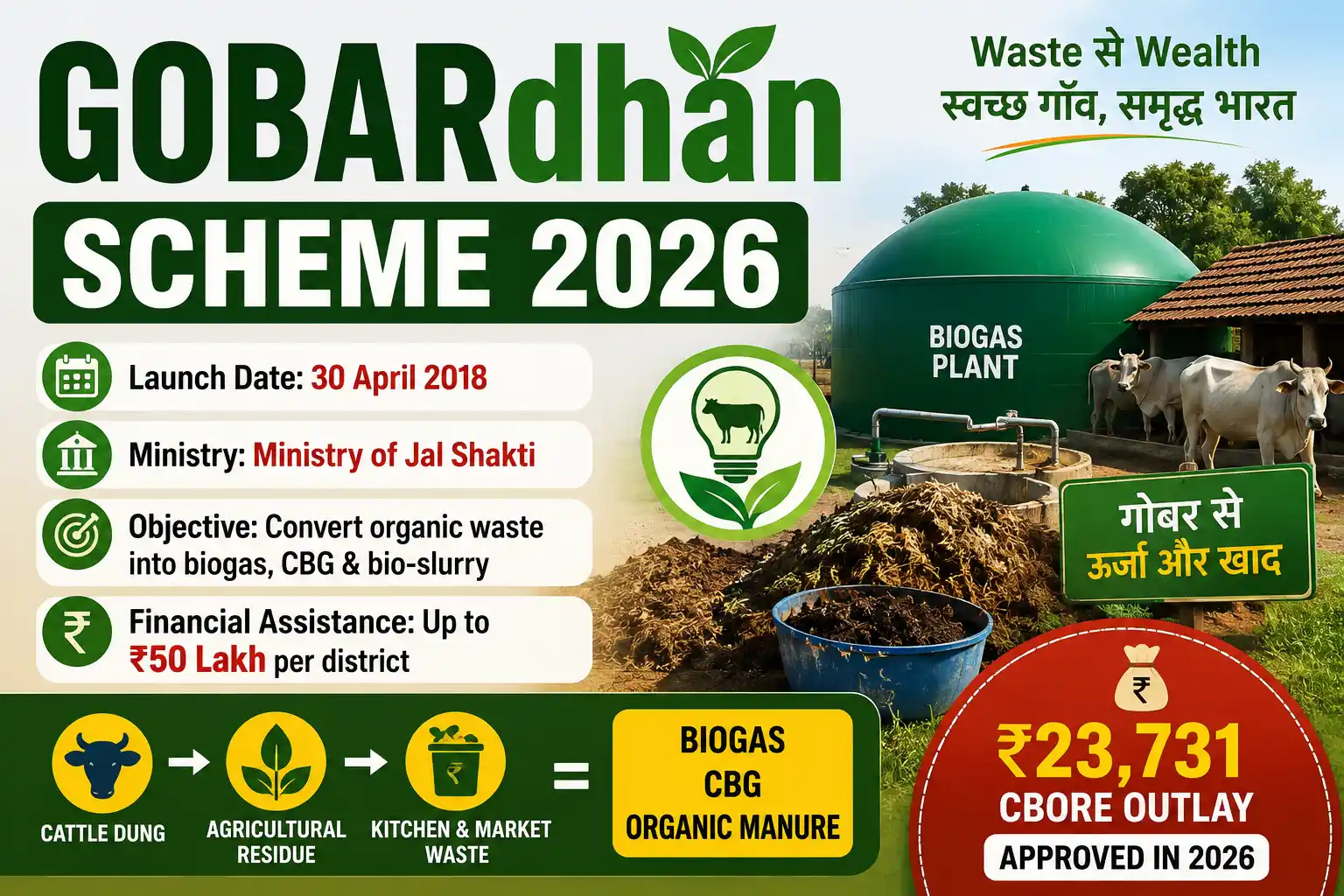
GOBARdhan Scheme is an important Government of India initiative focused on converting organic waste such as cattle dung, agricultural residue, kitchen waste and other biodegradable materials into biogas, compressed biogas (CBG) and bio-slurry/organic manure. The scheme connects rural sanitation, waste management, renewable energy, employment generation and the concept of a circular economy.
The original GOBARdhan initiative was launched on 30 April 2018 at Karnal, Haryana, under the then Ministry of Drinking Water & Sanitation and the Swachh Bharat Mission (Grameen). The Department of Drinking Water and Sanitation (DDWS), Ministry of Jal Shakti, has coordinated the initiative.
There is also an important 2026 development: on 6 August 2026, the Union Cabinet approved a new national circular bioenergy framework under the GOBARdhan name with an outlay of ₹23,731 crore, aimed at scaling up compressed biogas production.
GOBARdhan Scheme – Overview
| Particular | Details |
|---|---|
| Scheme Name | GOBARdhan Scheme |
| Full Form | Galvanizing Organic Bio-Agro Resources Dhan |
| Original Launch Date | 30 April 2018 |
| Launch Location | Karnal, Haryana |
| Ministry associated with original scheme | Ministry of Jal Shakti |
| Department | Department of Drinking Water and Sanitation |
| Linked Mission | Swachh Bharat Mission (Grameen) |
| Main Focus | Organic waste management and bioenergy |
| Major Inputs | Cattle dung, crop residue, kitchen and market waste |
| Outputs | Biogas, CBG and bio-slurry/organic manure |
| Financial assistance under SBM(G) | Up to ₹50 lakh per district for community/cluster biogas plants |
| New 2026 national framework | GOBARdhan National Circular Bioenergy Scheme |
| 2026 approved outlay | ₹23,731 crore |
The ₹50 lakh figure should not be interpreted as a universal cash subsidy paid to every individual. Under the SBM(G) framework, financial assistance is available for eligible community/cluster-based biogas plants at the district level, subject to applicable guidelines.
What is GOBARdhan Scheme?
GOBARdhan stands for Galvanizing Organic Bio-Agro Resources Dhan.
The basic idea is simple: instead of treating cattle dung and other biodegradable waste as useless waste, the government promotes its conversion into useful resources.
For example:
Cattle dung → Biogas → Cooking/energy
and
Biogas plant slurry → Bio-slurry → Organic manure
Similarly, agricultural residues and other biodegradable waste can become feedstock for bioenergy projects.
According to the Government of India, GOBARdhan is an integral component of solid waste management under Swachh Bharat Mission (Grameen) and supports the conversion of animal waste, kitchen leftovers, crop residue and market waste into biogas and bio-slurry.
The initiative therefore addresses several issues at the same time:
- Rural waste management
- Village cleanliness
- Renewable energy
- Organic manure production
- Farmer income
- Rural employment
- Reduction of uncontrolled biodegradable waste
- Promotion of a circular economy
GOBARdhan Scheme Full Form
The full form of GOBARdhan is:
Galvanizing Organic Bio-Agro Resources Dhan
The word GOBAR also makes the scheme easy to associate with cattle dung, which is one of the important raw materials used in biogas projects.
For UPSC and other competitive examinations, candidates should remember:
GOBARdhan = Galvanizing Organic Bio-Agro Resources Dhan
GOBARdhan Scheme Launch Date
The original GOBARdhan scheme was launched on:
30 April 2018
The national-level launch took place at Karnal, Haryana. The Government of India describes the initiative as having been launched in 2018 under Swachh Bharat Mission (Grameen).
The scheme was designed to help villages manage biodegradable waste while creating energy and economic opportunities from waste.
It was particularly significant because it connected the objectives of Swachh Bharat Mission, rural sanitation and waste-to-energy development.
GOBARdhan Scheme Under Which Ministry?
This is one of the most important questions for UPSC, SSC, Banking and other competitive examinations.
The original GOBARdhan initiative was implemented under the Department of Drinking Water and Sanitation, Ministry of Jal Shakti, as part of Swachh Bharat Mission (Grameen).
Ministry
Ministry of Jal Shakti
Department
Department of Drinking Water and Sanitation (DDWS)
The official DDWS website identifies itself as the Department of Drinking Water and Sanitation under the Ministry of Jal Shakti.
However, GOBARdhan is a multi-ministry initiative. Different government departments are involved in areas such as CBG, energy, petroleum, agriculture and waste management. The Government has described a whole-of-government approach to developing CBG projects under the initiative.
GOBARdhan Scheme Launched by Which State?
This question can be confusing because there were state-level initiatives with similar names.
Correct answer for the Central GOBARdhan Scheme:
The Central GOBARdhan scheme was launched nationally from Karnal, Haryana, on 30 April 2018.
The Government of India launched the initiative through the then Ministry of Drinking Water & Sanitation, with the launch taking place at Karnal in Haryana.
At the same time, Haryana had its own Gobardhan Yojana, announced earlier in February 2018, which was a state initiative focused on organic manure and cattle-related waste.
Therefore, students should distinguish between the two:
| Question | Correct information |
|---|---|
| Central GOBARdhan scheme launch | 30 April 2018 |
| Launch location | Karnal, Haryana |
| Central ministry at launch | Ministry of Drinking Water & Sanitation |
| Present ministry association | Ministry of Jal Shakti |
| Linked mission | SBM-Grameen |
| Haryana’s separate initiative | State-level Gobardhan Yojana |
So, saying simply “GOBARdhan is a Haryana government scheme” is not accurate when referring to the Central Government’s GOBARdhan initiative.
GOBARdhan Scheme Subsidy
One of the most searched questions is “GOBARdhan scheme subsidy”.
Under the SBM(G) Phase-II framework, financial assistance of up to ₹50 lakh per district is available for setting up community or cluster-based biogas plants.
This is an important distinction:
₹50 lakh is not a universal individual subsidy.
The assistance is connected with eligible community/cluster-level biogas projects and is implemented through the government programme and approved plans.
Earlier government documents specified financial assistance of up to ₹50 lakh per district for community or cluster-level biogas plants.
Therefore, applicants should not assume that every farmer or household will automatically receive ₹50 lakh.
What determines assistance?
The actual support depends on factors such as:
- Type of project
- Project structure
- Applicable government guidelines
- State/UT implementation
- Approved annual implementation plans
- Availability of funds
- Community or cluster requirements
The Government’s March 2026 clarification states that funds under SBM(G) are released to States/UTs according to approved Annual Implementation Plans and overall availability of the programme budget.
How Does the GOBARdhan Scheme Work?
The GOBARdhan model follows a waste-to-resource approach.
Step 1: Collection of organic waste
Organic waste such as cattle dung, crop residues, kitchen waste and suitable market waste is collected.
Step 2: Waste is transported to a plant
The collected biodegradable material is taken to an appropriate biogas or bioenergy facility.
Step 3: Anaerobic digestion
In a biogas plant, organic material is processed in an oxygen-limited environment.
Step 4: Biogas production
The process produces biogas containing methane and other gases. After appropriate treatment, biogas can be used for energy applications.
Step 5: Bio-slurry production
The remaining slurry can be processed and used as an organic manure resource.
Step 6: Economic value
The system can generate energy, manure, employment and business opportunities while reducing unmanaged organic waste.
This is why GOBARdhan is often described as a waste-to-wealth initiative.
GOBARdhan Scheme Benefits
The scheme provides environmental, agricultural and economic benefits.
1. Better Waste Management
Large quantities of cattle dung and biodegradable waste can create sanitation and disposal problems if unmanaged.
GOBARdhan promotes scientific processing of such waste.
2. Production of Biogas
Biogas can be used as a renewable source of energy, particularly in rural areas.
This can reduce dependence on conventional fuels for suitable applications.
3. Organic Manure
The digestion process produces bio-slurry, which can be utilized as an organic manure resource.
This creates an additional use for agricultural and animal waste.
4. Additional Rural Income
Waste that previously had little economic value can become a resource.
Farmers, entrepreneurs and local institutions can participate in activities related to collection, transportation, processing and plant operations.
5. Employment Generation
Biogas and CBG projects can create employment opportunities in:
- Waste collection
- Transportation
- Plant operation
- Maintenance
- Manure processing
- Marketing
- Local entrepreneurship
The Government has highlighted employment generation, farmer income and rural infrastructure development among the benefits associated with GOBARdhan projects.
6. Cleaner Villages
Proper management of cattle dung and other organic waste can contribute to improved village sanitation.
This supports the broader objectives of Swachh Bharat Mission (Grameen).
7. Promotion of Circular Economy
GOBARdhan follows a circular economy model:
Waste → Processing → Energy + Manure → Economic Value
Instead of throwing organic material away, the system attempts to recover useful resources from it.
GOBARdhan and Compressed Biogas (CBG)
GOBARdhan has increasingly become associated with Compressed Biogas (CBG).
CBG can be produced after purification and compression of biogas. It can serve as a cleaner gaseous fuel and has potential applications in transport and other energy uses.
The Government has adopted a whole-of-government approach for CBG projects, involving multiple Ministries and Departments.
The initiative also works alongside other government programmes and measures connected with the development of the CBG ecosystem.
GOBARdhan Scheme 2026: New Development
There is an important update for anyone searching for GOBARdhan Scheme 2026.
On 6 August 2026, the Union Cabinet approved GOBARdhan as the National Circular Bioenergy Scheme with a total outlay of ₹23,731 crore. The new framework is intended to accelerate the development of compressed biogas and transform agricultural residue, cattle dung, press mud, municipal organic waste and other biomass into clean fuel, organic manure and rural economic value.
The new framework focuses on measures including:
- Assured offtake
- Stable pricing
- Capital assistance
- Pipeline connectivity
- Access to finance
- Increased CBG production
- Farmer and rural entrepreneur participation
This means that the term GOBARdhan now has an important new policy dimension beyond its original SBM(G) waste-management framework.
For a 2026 article, it is therefore better not to present GOBARdhan as only a 2018 rural sanitation programme.
GOBARdhan Scheme and Swachh Bharat Mission
GOBARdhan is closely connected with Swachh Bharat Mission (Grameen).
Under SBM(G) Phase-II, it forms part of solid and liquid waste management efforts aimed at improving sanitation in rural areas.
The key concept is:
Clean Village + Waste Management + Renewable Energy + Organic Manure
Government documents describe GOBARdhan as an integral component of solid waste management under SBM(G).
This makes it relevant not only to sanitation but also to renewable energy, agriculture and rural development.
GOBARdhan Scheme UPSC Notes
For UPSC Prelims, the following facts are important:
GOBARdhan Full Form
Galvanizing Organic Bio-Agro Resources Dhan
Launch Year
2018
Launch Date
30 April 2018
Launch Location
Karnal, Haryana
Ministry
Ministry of Jal Shakti
Department
Department of Drinking Water and Sanitation
Related Mission
Swachh Bharat Mission (Grameen)
Main Objective
Conversion of biodegradable/organic waste into useful resources such as biogas and bio-slurry.
Major Feedstock
- Cattle dung
- Agricultural residue
- Kitchen waste
- Market waste
- Other biodegradable organic material
Financial Assistance
Up to ₹50 lakh per district for eligible community/cluster biogas plants under the relevant SBM(G) framework.
2026 Development
Union Cabinet approved a ₹23,731 crore National Circular Bioenergy Scheme under the GOBARdhan name.
GOBARdhan Scheme: Important Questions and Answers
| Question | Answer |
|---|---|
| What is GOBARdhan? | A government initiative for converting organic waste into useful resources such as biogas and bio-slurry. |
| What is the full form of GOBARdhan? | Galvanizing Organic Bio-Agro Resources Dhan |
| When was it launched? | 30 April 2018 |
| Where was it launched? | Karnal, Haryana |
| Under which mission? | Swachh Bharat Mission (Grameen) |
| Which Ministry? | Ministry of Jal Shakti |
| Which department? | Department of Drinking Water and Sanitation |
| What waste is used? | Cattle dung, crop residue, kitchen and other biodegradable waste |
| What does it produce? | Biogas, CBG and bio-slurry/organic manure |
| What is the assistance under SBM(G)? | Up to ₹50 lakh per district for eligible community/cluster biogas plants |
| Is it only a Haryana scheme? | No. The Central GOBARdhan initiative is a national programme. |
| 2026 Cabinet-approved outlay? | ₹23,731 crore |
Why is GOBARdhan Important for Rural India?
Rural India has a substantial amount of organic material from livestock and agricultural activities. If this material is not managed properly, it can contribute to sanitation problems and environmental pollution.
GOBARdhan attempts to change this equation.
Instead of:
Waste → Disposal
the programme encourages:
Waste → Resource → Energy + Manure + Income
This approach can help create local economic activity while supporting India’s renewable energy and waste-management objectives.
The model is particularly relevant to villages where cattle dung and agricultural biomass are readily available.
GOBARdhan Scheme vs Similar Schemes
GOBARdhan should not be confused with every government programme related to biogas or biomass.
| Programme/Initiative | Main Focus |
|---|---|
| GOBARdhan | Organic waste management, biogas, CBG and bio-slurry |
| Swachh Bharat Mission-Grameen | Rural sanitation and waste management |
| SATAT | Promoting production and use of CBG |
| Waste to Energy | Energy generation from waste |
| National Bioenergy Programme | Wider bioenergy development |
The Government has described GOBARdhan as involving multiple Ministries and linked initiatives, including CBG-related programmes.
Is GOBARdhan Scheme Only for Farmers?
No.
Although farmers and cattle owners can benefit from the wider ecosystem, the programme is not simply an individual farmer cash-benefit scheme.
Its implementation can involve:
- Gram Panchayats
- Rural communities
- Local entrepreneurs
- Biogas plant operators
- Farmers
- Cattle owners
- Government departments
- Private sector participants
- CBG developers
The exact eligibility and financial support depend on the particular component and applicable guidelines.
Conclusion
The GOBARdhan Scheme represents India’s effort to turn organic waste into economic and environmental value.
The original initiative was launched on 30 April 2018 at Karnal, Haryana, under the then Ministry of Drinking Water & Sanitation and the Swachh Bharat Mission-Grameen. It is now associated with the Ministry of Jal Shakti, particularly the Department of Drinking Water and Sanitation.
Under the SBM(G) framework, eligible community and cluster-level biogas projects can receive financial assistance of up to ₹50 lakh per district.
The latest 2026 development is especially important: the Union Cabinet approved a ₹23,731 crore National Circular Bioenergy Scheme under the GOBARdhan name, signalling a much larger policy push toward CBG, clean energy, rural entrepreneurship and waste-to-wealth.
For UPSC aspirants, the most important facts to remember are full form, 2018 launch, Karnal-Haryana launch location, Ministry of Jal Shakti, Department of Drinking Water and Sanitation, Swachh Bharat Mission (Grameen), ₹50 lakh district-level assistance under the relevant SBM(G) component, and the ₹23,731 crore 2026 national circular bioenergy framework.
Also read:-

Dharitri Assam is an Assam-focused information platform providing the latest updates on government jobs, education, schemes, scholarships, admit cards, results, and career opportunities. Our goal is to make useful and reliable information easy to understand and accessible to everyone in Assam.